Voyager 1 one light-day from Earth: milestone due Nov 18
Voyager 1 will be one light-day from Earth on Nov 18, 2026, NASA says: about 25.9 billion km away, 49 years after launch. Signals take a day each way.
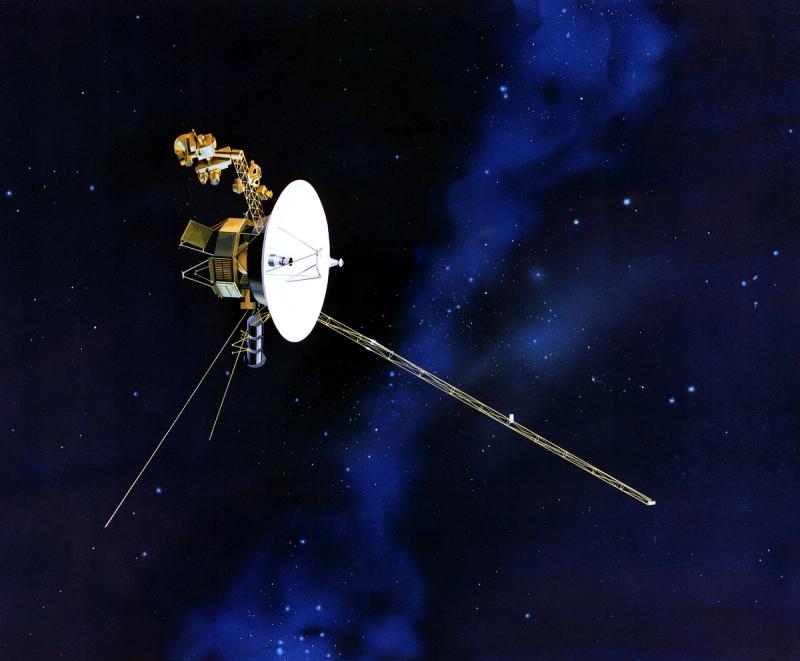
NASA's Voyager 1 is due to become the first spacecraft to reach one light-day from Earth, the distance light travels in 24 hours, on Wednesday, November 18, 2026, at 10:16 UTC, according to NASA, EarthSky and Science News. It will then be about 25.9 billion kilometres (16.1 billion miles) away, 49 years after its launch, and NASA says no other human-made object has come so far.
Key facts
- Voyager 1 reaches one light-day from Earth on November 18, 2026, at 5:16 a.m. EST (10:16 UTC), according to NASA.
- One light-day is about 25.9 billion kilometres (16.1 billion miles).
- That is about 173 times the distance between Earth and the Sun, EarthSky says.
- Voyager 1 was launched on September 5, 1977.
- It entered interstellar space in August 2012.
- Signals between Earth and the spacecraft now take about a day each way.
What does Voyager 1 one light-day from Earth mean?
A light-day is the distance light covers in one day. At that distance, a command sent from Earth takes about a day to reach Voyager 1, and its reply takes about another day to come back, according to NASA, EarthSky and Science News. NASA gives the exact distance at the milestone as 25,902,068,356 kilometres.
For comparison, sunlight reaches Earth in about 8 minutes and 20 seconds, and light from the Moon takes about 1.3 seconds, according to NASA. Even Neptune, the most distant planet, is only about four light-hours away. In early October, light from Voyager 1 was taking 23 hours, 52 minutes and 30 seconds to reach Earth, EarthSky reported.
A 49-year journey
Launched on September 5, 1977, Voyager 1 has travelled for 49 years, two months and 11 days to reach this point, according to NASA and EarthSky. It crossed into interstellar space, beyond the Sun's protective bubble, in August 2012. Its twin, Voyager 2, is expected to reach the same distance in November 2035.
The probe's first job was to fly past Jupiter and Saturn. Its images revealed active volcanoes on Jupiter's moon Io, the first found beyond Earth, Science News reported. In 1998 it overtook Pioneer 10 to become the most distant human-made object, and in 1990, at Carl Sagan's urging, it took the "Pale Blue Dot" picture showing Earth as a faint speck.
Science News reported that Voyager 1 crossed the heliopause, the edge of the Sun's bubble of solar wind, on August 25, 2012, about 18 billion kilometres from the Sun. Like its twin, it carries a gold-plated record of sounds and images from Earth, including greetings in dozens of languages, whale song and music.
Is Voyager 1 still working?
"Voyager, to this day, is a multi-generational mission," Linda Spilker of NASA's Jet Propulsion Laboratory told Science News, which reported that the spacecraft's power supply is expected to last 10 to 15 more years. NASA has invited the public to mark the moment after sunset on November 17 with an event called "Shine Bright for Voyager's Light-Day".
Participants are asked to flash the letters V-G-R, for Voyager, in Morse code with a phone or torch, EarthSky reported. The event falls on the evening before the milestone, which arrives early on November 18 in the Americas.
The nuclear-powered probe is running low on power. On April 17, 2026, engineers shut off its Low-energy Charged Particles instrument, which had worked almost continuously since 1977, according to NASA's Jet Propulsion Laboratory. Each Voyager carries 10 sets of instruments, and the team agreed years ago on the order in which they would be switched off. The same instrument on Voyager 2 was turned off in March 2025, JPL said.
Where is Voyager 1 going?
Voyager 1 is heading out of the plane of the planets towards the constellation Ophiuchus, EarthSky said. NASA says it is moving towards the star Gliese 445, more than 17 light-years away, and will pass within about 1.7 light-years of it in about 40,000 years. Voyager 2 is heading the other way and is about 3.2 billion kilometres closer to Earth, according to EarthSky.
For more space news, see how SpaceX caught a Starship with its launch tower after orbit, how astronomers found a likely heavy neutron star, and ESA's Euclid data release on more than 900 million galaxies.
What is still unclear
Some outlets have given other dates for the milestone; NASA's date is November 18. How long Voyager 1 can keep sending data depends on its declining power supply.
Scientists are also still puzzling over what the probe has measured outside the heliosphere. Science News reported four jumps in magnetic field strength and particle density since the crossing, with readings staying high since the fourth, in mid-2020, for reasons that are not known. The shape of the heliosphere itself is still debated.
Frequently asked questions
When will Voyager 1 be one light-day from Earth?
On November 18, 2026, at 10:16 UTC, according to NASA.
How far is one light-day?
About 25.9 billion kilometres, or 16.1 billion miles.
Is Voyager 1 still working?
Yes. It still communicates with Earth, though its power is declining and NASA has switched off some instruments to save energy.
Will Voyager 2 reach one light-day too?
Yes, but not until November 2035, according to NASA. It is slower and closer to Earth, so it will not catch up with its twin.
Photo: NASA/JPL (public domain).
Sources
- NASA Science Official or original
- NASA Scientific Visualization Studio Official or original
- EarthSky News outlet
- Science News News outlet
- NASA Jet Propulsion Laboratory (JPL): instrument shut off on Voyager 1 Official or original
Also available inالعربية