Heavy neutron star likely found orbiting a red giant
A Science Advances study reports a likely heavy neutron star of about 2.2 solar masses orbiting a red giant, in a wide orbit theory struggles to explain.
Astronomers have found an unseen object of about 2.2 times the mass of the Sun orbiting a red giant star, most likely an unusually heavy neutron star, in a system that standard theory struggles to explain, according to a peer-reviewed study in Science Advances reported by Phys.org and 404 Media. The system, J0008+0128, was described in reports published on November 11 and 13.
Key facts
- The system is called J0008+0128.
- The hidden companion was detected through its pull on a red giant star, using spectroscopic surveys and Gaia data.
- Its mass is estimated at 1.8 to 2.8 solar masses, with a best estimate of about 2.2.
- The orbit is unusually wide, about 3.3 years.
- The study is peer-reviewed and published in Science Advances.
- In about 300,000 computer simulations of two-star systems, none reproduced it, according to Phys.org.
What did astronomers find?
The researchers detected the companion by its gravitational pull on the red giant, using spectroscopic surveys and data from the European Space Agency's Gaia mission, according to Phys.org and 404 Media. Phys.org reported a mass range of 1.8 to 2.8 solar masses, with a best estimate of 2.2, and an orbital period of about 3.3 years; 404 Media gave the period as 1,218 days, which is consistent.
The spectra came from China's LAMOST survey and the APOGEE survey of the Sloan Digital Sky Survey, Phys.org reported. No light other than the red giant's was detected, so the companion is not an ordinary star. The orbit is close to circular, and the study's lead author is Xinlin Zhao.
"We have found more than 10 neutron stars, and J0008+0128 is the most massive one," co-author Song Wang of the National Astronomical Observatories of China told 404 Media.
Why is a heavy neutron star puzzling?
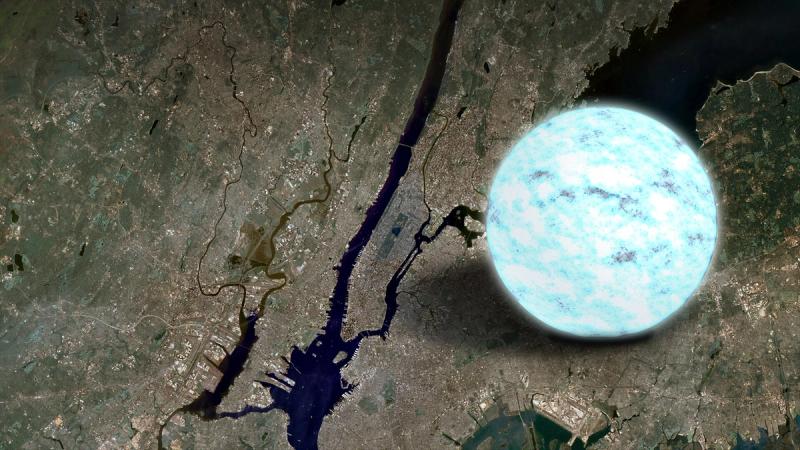
A neutron star is the collapsed core of a massive star. Most weigh about 1.4 solar masses, packed into a ball roughly 10 kilometres across, and above a limit thought to lie somewhere between about 2.2 and 2.9 solar masses one should collapse into a black hole, according to reference works.
The upper end of the mass range would fall into the gap between the heaviest known neutron stars and the lightest black holes, roughly 2.5 to 5 solar masses, both outlets reported. Phys.org noted that no neutron star above 2.5 solar masses had been found before. Weighing such objects also helps physicists test how matter behaves at extreme densities, 404 Media reported.
A neutron star can gain mass by pulling gas from a partner, but 404 Media reported that the red giant is too far away for that to explain this one's weight.
How could it have formed?
In simulations, none reproduced a system like this, and alternatives include a past three-body system in which two objects merged. Phys.org put the number of simulations at around 300,000; 404 Media described them as thousands. The authors wrote that the wide, near-circular orbit is "difficult to explain through standard binary evolution channels".
If the pair did form as an isolated binary, it may have needed an unusually efficient shedding of a shared gas envelope, a high birth mass for the neutron star and only a tiny kick from its supernova, Phys.org reported. Other ideas listed include:
- a triple system with two smaller neutron stars close together and the red giant further out;
- a triple system of a neutron star, a white dwarf and the red giant;
- a former triple in which the two inner bodies merged;
- a very small black hole, though none that light has been identified.
How does it compare with other objects?
The closest comparison is Gaia NS1, a neutron star candidate of about 1.9 solar masses in a 731-day orbit, described by Kareem El-Badry and colleagues in 2024. It was also found through Gaia's precise tracking of a visible star's wobble. Among pulsars, PSR J0952-0607 is estimated at about 2.35 solar masses, one of the heaviest neutron stars known.
In 2019, the LIGO and Virgo gravitational-wave detectors recorded a merger involving an object of about 2.6 solar masses, inside the same gap. When announcing it in June 2020, LIGO said scientists could not tell whether it was a neutron star or a black hole. For more space science, see ESA's Euclid telescope releases data on more than 900 million galaxies, and how Voyager 1 is nearing one light-day from Earth.
What is still unclear, and what comes next?
The object's identity is not confirmed; "likely" is the authors' word. Only the upper end of the mass range falls in the mass gap, not the best estimate. 404 Media reported that Gaia's next data release, due next month, may narrow the mass.
ESA has scheduled that release, Gaia Data Release 4, for December 2, 2026. It will cover the first 5.5 years of observations by the spacecraft, which stopped collecting science data in January 2025, according to ESA.
Frequently asked questions
What is a neutron star?
The extremely dense core left after a massive star explodes, packing more than the Sun's mass into a sphere about the size of a city. The first were spotted as pulsars by Jocelyn Bell Burnell and Antony Hewish in 1967.
What is the mass gap?
A range, roughly 2.5 to 5 solar masses, between the heaviest known neutron stars and the lightest known black holes, where few objects have been found.
Is the study peer-reviewed?
Yes. It was published in Science Advances.
How can astronomers weigh something they cannot see?
By measuring how much it tugs on a visible partner. The red giant's motion, tracked by spectra and by Gaia, reveals the mass and orbit of its hidden companion.
Photo: NASA's Goddard Space Flight Center (public domain).
Sources
- Phys.org News outlet
- 404 Media News outlet
- European Space Agency (ESA): Gaia mission news Official or original
- El-Badry et al., A 1.9 solar-mass neutron star candidate in a 2-year orbit (arXiv) Official or original
- LIGO Caltech: GW190814 mass-gap object Official or original
- Wikipedia: Neutron star News outlet
Also available inالعربية