COP31: Guterres urges deep cuts as fossil fuels split talks
At his last UN climate summit, Guterres urged drastic emission cuts as COP31 talks in Antalya split over fossil fuels. A first draft deal is due next week.
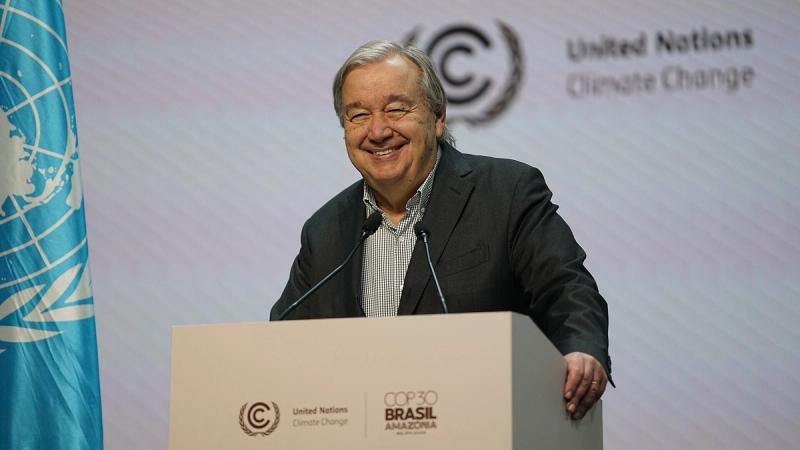
UN Secretary-General António Guterres called on Friday, November 13, for an immediate and drastic cut in greenhouse gas emissions, as the first week of the COP31 climate conference in Antalya, Türkiye, closed with governments divided over fossil fuels and no draft agreement yet on the table, according to Reuters and the Associated Press.
Key facts
- COP31, the United Nations climate conference, runs from November 9 to 20, 2026, in Antalya, Türkiye.
- It is Guterres's last climate summit as secretary-general. Reuters reports that he steps down at the end of December after two five-year terms.
- The United States is not taking part, for the second year in a row under President Donald Trump.
- Australia, which leads the negotiations in a shared presidency with Türkiye, is taking national submissions until Saturday night and expects a first draft text early next week.
- Guterres has proposed a climate justice compact and urged governments to tax the windfall profits of fossil fuel companies.
- He called for emissions to fall by about 6 percent a year for several years, the AP reported.
What did Guterres say at COP31?
Speaking to reporters, Guterres pressed governments for an immediate and drastic reduction in emissions and urged big emitters to keep the 1.5°C goal of the 2015 Paris Agreement within reach, according to Reuters. "You cannot build peace on a burning planet," he said, as quoted by the AP.
He also criticised the fossil fuel industry. Reuters reported his warning about the industry's outsized influence. In a speech two days earlier, UN News reported, he said the lobby distorts science and delays action.
At the leaders' summit on Wednesday, November 11, Guterres proposed a climate justice compact built on four priorities, according to UN News:
- Moving away from fossil fuels through national plans that protect workers and communities, while expanding renewables.
- Protecting vulnerable people, including through early-warning systems and stronger adaptation.
- Making climate finance affordable, with wealthy countries meeting their commitments.
- Strengthening cooperation between countries on trade barriers and technology gaps.
In the same speech he called for taxes on the windfall profits of fossil fuel companies. He contrasted the $95 billion earned in a single quarter by the world's nine largest oil companies with the roughly $600 million received by the international fund for loss and damage, UN News reported.
He also warned, the AP reported, that even tripling finance for climate adaptation would meet less than 30 percent of what vulnerable countries need. Euronews, citing the UN Environment Programme, put the share at 23 to 29 percent.
Why do fossil fuels divide climate summits?
The future of coal, oil and gas is the most sensitive question of every climate summit. At COP28 in Dubai in 2023, the decision known as the UAE Consensus called for the first time for transitioning away from fossil fuels in energy systems in a just and orderly way, alongside tripling renewable capacity by 2030, according to the World Resources Institute.
Two years later, the Global Mutirão decision adopted at COP30 in Belém, Brazil, on November 22, 2025, did not mention fossil fuels explicitly, even though more than 80 countries had called for a roadmap away from them, Climate Home News reported. Brazil's presidency instead announced voluntary roadmaps outside the UN process.
In Antalya, Reuters noted that Saudi Arabia and Russia have traditionally resisted limits on fossil fuels, and that India has opposed measures it says would hold back its development. Citing an observer from the think tank E3G, it reported that India and the G77 group do not want firm targets or fuel-specific language. Climate Home News reported that some large developing countries pushed back against targets for individual sectors.
Host country Türkiye wants a deal centred on expanding the use of electricity, through its contested 35 by 35 pledge. Turkish President Recep Tayyip Erdoğan told leaders that three decades of climate talks had not delivered enough results, and Brazilian President Luiz Inácio Lula da Silva said Brazil would draw up national roadmaps to cut its dependence on fossil fuels and end deforestation, UN News reported.
Where is global warming heading?
Estimates of future warming vary with the assumptions behind them. Guterres said the world is heading for more than 2.5°C of warming even if countries fully carry out their national climate plans, according to UN News. An analysis by the research group Climate Action Tracker, published on Thursday and reported by the AP, puts warming at 2.6°C if all pledges are met.
Reuters noted that a UN report last month found the world on course to overshoot the 1.5°C limit. That report, UNEP's Emissions Gap Report released on October 21, projected about 2.8°C under current policies and said emissions must fall 45 percent from 2025 levels by 2035, Health Policy Watch reported. Its findings have sparked a row inside COP31.
Who runs COP31, and who is missing?
The summit rests on an unusual deal announced in Belém on November 20, 2025, which ended a stalemate of more than a year between rival bids from Türkiye and Australia. Türkiye hosts the conference while Australia holds the presidency of the negotiations, Climate Home News reported. Australia's Chris Bowen runs the talks, and Türkiye's Murat Kurum leads the voluntary Action Agenda.
The United States, the world's second-largest polluter after China, is absent. Trump announced the exit from the Paris Agreement on his first day in office, January 20, 2025, and it took effect on January 27, 2026, according to E&E News.
What happens next, and what is still unclear?
Negotiators expect the first draft of a deal early next week, leaving a few days to settle the hardest questions before the conference is due to close on November 20. Ministers are arriving to take over the most contested files, including adaptation finance, where African countries want it tripled to at least $120 billion a year by 2035, Climate Home News reported. UN climate chief Simon Stiell called progress "constructive".
Outside the venue, thousands of people marched through Antalya in the rain on Saturday, Climate Home News reported.
There is no draft text yet, so it is not known whether a final agreement will mention a transition away from fossil fuels, or how strongly. The current cover text is still a wishlist that includes an option welcoming Brazil's roadmap. Figures for expected warming differ between sources because they rest on different scenarios.
Frequently asked questions
When and where is COP31?
COP31 takes place in Antalya, Türkiye, from November 9 to 20, 2026, under a shared presidency of Türkiye and Australia.
Is the United States at COP31?
No. For the second year in a row under President Trump, the United States is not taking part in the UN climate talks, after its exit from the Paris Agreement took effect in January 2026.
What is the climate justice compact?
It is a proposal by Guterres built on four priorities: moving away from fossil fuels, protecting vulnerable people, affordable finance, and cooperation between countries.
What did COP28 decide on fossil fuels?
The 2023 UAE Consensus called for transitioning away from fossil fuels in energy systems, the first time a formal COP outcome named fossil fuels.
Photo: Xuthoria / Wikimedia Commons, licence CC BY-SA 4.0.
Sources
- Reuters, via The Star News agency
- Associated Press, via The Press Democrat News agency
- UN News Official or original
- Climate Home News News outlet
- Euronews News outlet
- Climate Home News: COP31 hosting deal (Nov 2025) News outlet
- Climate Home News: COP30 outcome (Nov 2025) News outlet
- World Resources Institute: COP28 outcomes News outlet
- E&E News: US leaves the Paris Agreement News outlet
- Health Policy Watch: UNEP Emissions Gap Report 2026 News outlet
Also available inالعربية