Basal ganglia atlas maps 25 million cells in primates
A new basal ganglia atlas from the NIH-funded BICAN network maps about 25 million cells in humans and monkeys, a baseline for Parkinson's research.
Scientists have published the most detailed basal ganglia atlas yet, a cell-by-cell map of the deep brain structures involved in movement, habits and reward, covering about 25 million cells from humans, macaques and marmosets. The work, released on Thursday, November 12, in a package of papers across Cell Press journals, is part of the BRAIN Initiative Cell Atlas Network (BICAN), funded by the US National Institutes of Health.
Key facts
- The atlas covers about 25 million cells; Nature reports 25.5 million, including 21 million human cells from six donors.
- Species: humans, macaque monkeys and marmosets, with comparisons to earlier mouse maps.
- Published on November 12, 2026, in Cell Press journals including Cell and Cell Reports Methods.
- Funded through the NIH BRAIN Initiative, as part of BICAN.
- The basal ganglia are linked to Parkinson's disease, Huntington's disease and addiction; the Salk Institute adds Tourette syndrome.
- BICAN's website says the consortium has more than 600 members from 55 institutions in nine countries.
What does the basal ganglia atlas show?
According to Nature, the package draws on about 21 million human cells from six donors, 3 million macaque cells from three animals and 1.5 million marmoset cells from two animals. Researchers identified 61 cell types shared by all three primates, which Nature reports have been conserved for about 76 million years of evolution.
Other papers in the package describe molecular zones within the human and macaque striatum, a key part of the basal ganglia, and show that the cellular makeup of the region varies from person to person, Nature reported.
BICAN says the package combines more than five kinds of measurement, from gene activity inside single cells to their position in tissue and chemical marks on DNA. Its work on ageing and on differences between individuals drew on more than 150 donors.
One Salk-led paper in Cell profiled DNA methylation and the 3D folding of the genome in 197,003 cells from seven donors. Combined with existing data, its unified epigenetic atlas covers 261,331 cells, and it found region-specific methylation patterns and different genome organisation in neurons compared with other brain cells, the institute said.
What are the basal ganglia and what do they do?
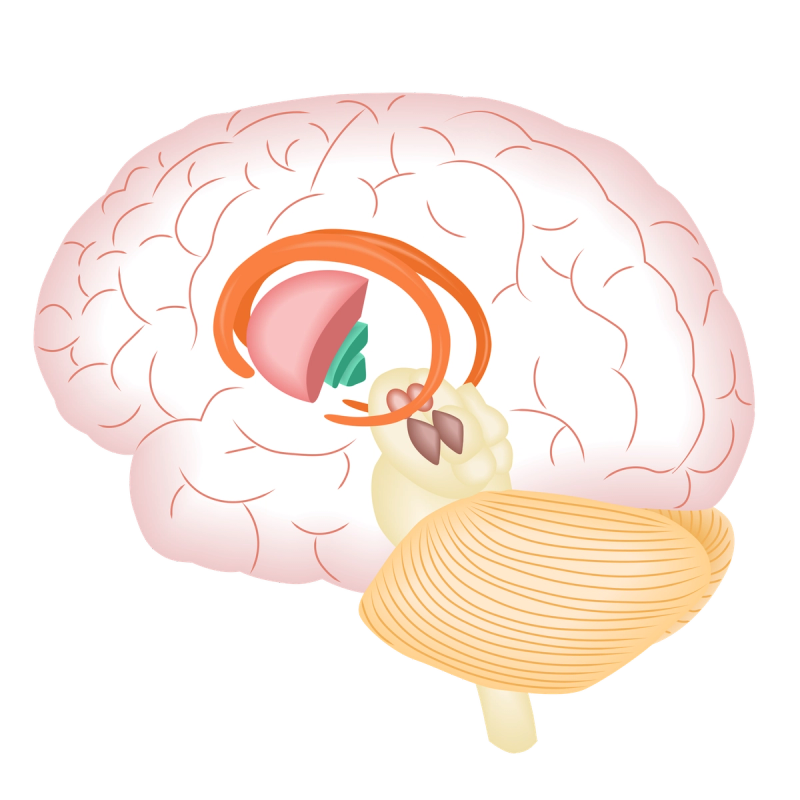
The basal ganglia are clusters of nerve cells at the base of the forebrain and the top of the midbrain, tightly wired to the cerebral cortex, the thalamus and the brainstem. Their largest part is the striatum, made up of the caudate and the putamen and, lower down, the nucleus accumbens. Other parts include the globus pallidus, the substantia nigra and the subthalamic nucleus.
Scientists think the circuit helps the brain choose which action to carry out while holding back others. It also contributes to habit formation, eye movements, motivation and decision-making. Dopamine, released mainly by cells in the substantia nigra and the nearby ventral tegmental area, strongly shapes its activity.
Why it matters for disease
The basal ganglia help start and control movement and are central to how habits and rewards are learned. Disorders including Parkinson's disease, Huntington's disease and addiction involve this region, according to both Nature and the Salk Institute. A detailed reference map of its cells gives researchers a baseline against which changes in disease can be compared.
In Parkinson's disease, dopamine-producing cells in the substantia nigra are lost, while Huntington's disease mainly damages the striatum. The World Health Organization estimates that more than 8.5 million people were living with Parkinson's in 2019, that prevalence doubled over the previous 25 years, and that the disease caused 329,000 deaths that year, more than twice the number in 2000.
The Salk researchers say the atlas could help link genetic risk variants to specific cell types, point to genetic and epigenetic targets for gene editing, and support more personalised treatments.
How did we get here?
The US BRAIN Initiative was launched on April 2, 2013, under President Barack Obama, inspired by the Human Genome Project and involving the NIH, the defence research agency DARPA and the National Science Foundation. In 2017 the BRAIN Initiative Cell Census Network (BICCN) began a programme to catalogue the brain's cell types.
On October 12, 2023, that network published 21 papers in Science and two sister journals, describing more than 3,000 types of human brain cell in over a million cells from 100 regions, according to the Allen Institute. On December 13, 2023, ten papers in Nature presented the first complete cellular map of an adult mouse brain, covering about 32 million cells and more than 5,300 cell types.
BICAN is the next phase. Nature describes it as a 500 million dollar project launched in 2022 with hundreds of scientists in nine countries. One of its main parts, the Human and Mammalian Brain Atlas led by the Allen Institute, aims to map and compare cell types across humans, macaques and marmosets, and the basal ganglia are its first release.
Researchers involved include Michael Hawrylycz of the Allen Institute. According to the Salk Institute, co-corresponding authors of the flagship Cell paper also include Ed Lein, Carol Thompson and Hongkui Zeng of the Allen Institute and Bing Ren of the New York Genome Center. Salk says it led or contributed to eight of the papers and has made a public version of its part of the atlas available online.
On the same day, two studies in Science traced person-to-person spread of hantavirus on the cruise ship Hondius. And the European Space Agency has recently released Euclid data on more than 900 million galaxies, another example of a very large open scientific dataset.
What is still unclear
Reports differ on the size of the package: Nature counts 26 papers in six journals, while the Salk Institute and the BICAN website refer to 28. A Salk image caption also mentions roughly 24 million cells, against 25.5 million in Nature and on the BICAN site.
The atlas describes healthy tissue; turning it into treatments will require further research. It does not yet show how these cells change in patients, which will need new comparisons.
Frequently asked questions
What are the basal ganglia?
A group of structures deep in the brain that help control movement and are involved in habits and reward. The largest part is the striatum.
How many cells does the new atlas cover?
About 25 million cells from humans, macaques and marmosets; Nature gives a figure of 25.5 million.
Are the findings peer-reviewed?
Yes. The papers were published in peer-reviewed Cell Press journals.
Can anyone look at the data?
Yes. The Salk Institute offers a public, browsable version of its atlas, the papers are listed on the Cell Press and BICAN websites, and the data are released through BRAIN Initiative archives.
Photo: DBCLS TogoTV, licence CC BY 4.0.
Sources
- Nature News outlet
- Salk Institute Official or original
- BRAIN Initiative Cell Atlas Network (BICAN): Basal ganglia package Official or original
- Allen Institute: Human and Mammalian Brain Atlas (HMBA) Official or original
- Allen Institute: cellular maps of the human brain (October 2023) Official or original
- Allen Institute: first complete cellular map of the adult mouse brain (December 2023) Official or original
- World Health Organization: Parkinson disease fact sheet Official or original
- Wikipedia: BRAIN Initiative News outlet
- Wikipedia: Basal ganglia News outlet
Also available inالعربية