Iranian drone attack on Bahrain intercepted, military says
Bahrain says it intercepted an Iranian drone attack on Bahrain, its first alert since September; the IRGC says it targeted a US radar at Al-Rifaa.
Bahrain's military said on Sunday, November 15, that its air defences had intercepted and destroyed several Iranian aerial attacks before they reached their targets, while Iran's Islamic Revolutionary Guard Corps (IRGC) said it had attacked a base in Bahrain hosting US assets, according to The National and AFP. It was the second Iranian drone attack on Bahrain in three days, according to AFP. No casualties or damage were reported by any side.
Residents of Manama heard explosions at about 4am local time and a second series of blasts at around 6.30am, according to an AFP report published by RTÉ. Sirens sounded across the kingdom. "I was hoping this period was behind us," a shopkeeper in the capital told the agency.
Key facts
- Bahrain's military says air defences "confronted, intercepted and destroyed" several Iranian aerial attacks.
- These were Bahrain's first such interceptions and nationwide safety warnings since September.
- The IRGC says it sent six drones at a US air-defence radar at the Al-Rifaa helicopter base.
- Neither US nor Bahraini authorities confirmed the IRGC's claim at the time.
- No casualties or damage were reported.
What Bahrain says
Bahrain's military said its air defences had stopped several Iranian aerial attacks before they reached their targets and accused Tehran of a "systematic hostile approach" toward the kingdom, according to The National. The Interior Ministry twice told residents to stay calm and go to the nearest safe location. It was the first such alert in Bahrain since September, The National and AFP reported.
The foreign ministry said air defence systems had shot down Iranian drones, and said Bahrain rejects its territory being turned into an arena for settling scores, holding Iran fully responsible, AFP reported. Saudi Arabia expressed solidarity with Bahrain and called the strikes "blatant Iranian attacks" that violate international law, according to The National.
What Iran says
The IRGC said it had attacked a base hosting US assets in retaliation for what it called hostile US actions, and that it had sent six drones at a US air-defence radar at the Al-Rifaa helicopter base, according to The National, citing Iranian media. Two days earlier, the IRGC had claimed an attack on a US early-warning radar in Bahrain; that claim was not independently confirmed.
The IRGC described Sunday's strike as a second phase of retaliation, The National reported. According to AFP, the Friday attack followed US strikes earlier in November on Iran's Qeshm island in the Strait of Hormuz, and the IRGC warned that any US aggression would meet a harsher response.
What did the US say?
On Sunday, neither the US military nor Bahraini authorities immediately confirmed the IRGC’s claim, according to Reuters via The Globe and Mail, and the reports reviewed carry no US statement about Sunday’s drones. Two days earlier, on Friday 13 November, after the IRGC said it had destroyed an early-warning radar in Bahrain, the US military denied the claim: CBS reported that US Central Command said on social media there were no injuries or damage and that both Iranian drones were shot down by US forces, and CNBC and Reuters likewise reported that US forces intercepted two Iranian drones without damage. Sunday’s IRGC claim, of six drones aimed at a radar at the Al-Rifaa (also spelt Al-Riffa) base, is a separate claim that remains unconfirmed.
Reports differ on how many tankers the Guards said had struck mines in the Strait of Hormuz: two according to CNBC and The National, three according to CBS. Reuters said it could not verify the claim.
Why was there an Iranian drone attack on Bahrain?
Bahrain hosts Naval Support Activity Bahrain, the headquarters of both US Naval Forces Central Command and the Fifth Fleet. The fleet was reactivated in 1995 and covers about 2.5 million square miles, including the Gulf, the Red Sea, the Arabian Sea and parts of the Indian Ocean, according to Wikipedia.
Relations between Manama and Tehran were already poor before the war. Bahrain cut diplomatic ties with Iran in January 2016, and in 2020 it established relations with Israel under the US-brokered Abraham Accords, Wikipedia notes.
How did we get here?
The war began on February 28, when the United States and Israel struck Iran, according to The National and AFP. AFP reports that those first strikes killed Iran's supreme leader, Ayatollah Ali Khamenei. Iranian drones and missiles began hitting Bahrain about two hours later, many aimed at the US naval headquarters, while others hit residential buildings and a hotel, Defense One reported in March. The Juffair district around the base was evacuated and Bahrain's airspace was closed.
Attacks have come in waves since then. In July, Bahrain's army said it had repelled a new wave of Iranian aerial attacks, according to an AFP report carried by the Oman Observer. In May, Bahrain and the United States circulated a draft UN Security Council resolution demanding that Iran stop attacks on shipping in the Strait of Hormuz, UN News reported.
The wider conflict
Bahrain hosts the US Navy's Fifth Fleet. US President Donald Trump has said he might hold off on attacking Iran if there are no new provocations from Tehran or from Yemen's Houthis, and that the US naval blockade will remain, The National reported. The Saudi-led coalition said it had intercepted two Houthi ballistic missiles aimed at Riyadh. For the toll on shipping, see UN says 25 seafarers killed in and around the Strait of Hormuz.
On Friday, Gulf states asked the UN Security Council to make Iran pay full compensation for thousands of missile and drone attacks since February, The National reported. A US official said on Friday that Trump plans to discuss the conflict at his three-way meeting with the Chinese and Russian leaders this week, AFP reported.
What is still unclear
It has not been independently confirmed what was targeted or whether any drone reached Bahraini territory. Reports also differ on the number of drones intercepted over Saudi Arabia's Eastern Province: three according to the Saudi Press Agency, as cited by The National, but two in a summary on the same page.
The IRGC's navy also claimed that two tankers exploded after hitting mines on Saturday night on an unauthorised route south of the Strait of Hormuz; The National said the claim was unverified and no vessels were named.
Frequently asked questions
What happened in Bahrain on November 15?
Bahrain's military says it intercepted several Iranian aerial attacks, and residents were twice told to take shelter. No casualties were reported.
What did Iran say?
Iran's Revolutionary Guards said they sent six drones at a US radar at the Al-Rifaa base. This was not confirmed by the US or Bahrain at the time.
Why is Bahrain involved?
Bahrain hosts the US Navy's Fifth Fleet, and the region has been affected by the war that began with US and Israeli strikes on Iran on February 28.
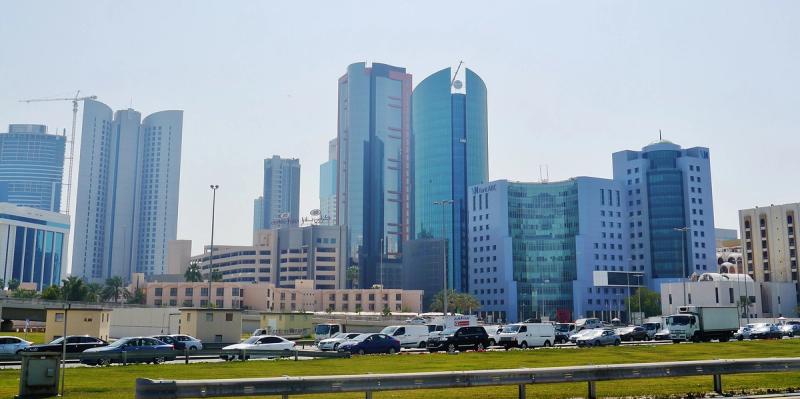
Photo: Zairon, licence CC BY-SA 4.0.
Sources
- The National News outlet
- AFP, via RTÉ News agency
- Defense One: an American in Bahrain describes days of drone and missile attacks (March 2026) News outlet
- AFP, via Oman Observer: Bahrain says it thwarted new wave of Iranian attacks (July 2026) News agency
- UN News: Bahrain and US float Security Council resolution on Hormuz (May 2026) Official or original
- Wikipedia: United States Fifth Fleet News outlet
- Wikipedia: Bahrain-Iran relations News outlet
- CBS News live updates (Nov 13 and 15 entries) News outlet
- CNBC (citing Reuters), 15 November 2026 News outlet
Also available inالعربية